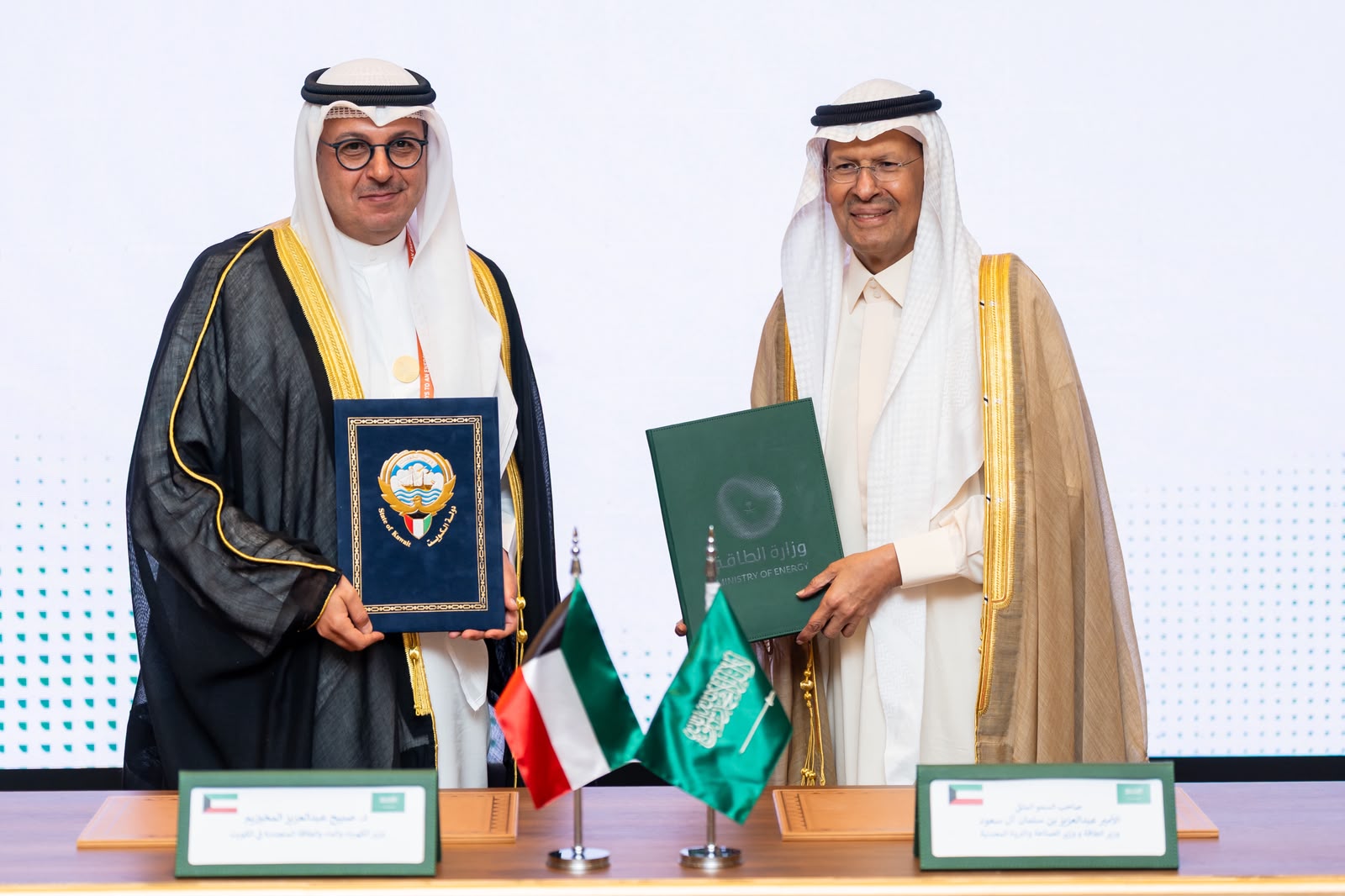
The Government of the State of Kuwait, represented by the Ministry of Electricity, Water and Renewable Energy, and the Government of the Kingdom of Saudi Arabia, represented by the Ministry of Energy, have signed a Memorandum of Understanding (MOU) on cooperation in the fields of electricity and renewable energy. The memorandum of understanding aims to strengthen bilateral relations and open up broader horizons for partnership between the two brotherly countries.
The Kuwaiti side was represented at the signing by Dr. Subaih Abdulaziz Al-Mukhaizeem, Minister of Electricity, Water and Renewable Energy, while the Saudi side was represented by His Royal Highness Prince Abdulaziz bin Salman bin Abdulaziz Al Saud, Minister of Energy and Minister of Industry and Mineral Resources.
Dr. Al-Mukhaizeem affirmed that the signing of the memorandum of understanding reflects the depth of the fraternal relations between the State of Kuwait and the Kingdom of Saudi Arabia and marks the beginning of a new phase of bilateral cooperation, supporting the shared interests and development priorities of the two brotherly countries.
He stated: “This memorandum of understanding represents an important step towards building high-value partnerships that bring together the capabilities and expertise of both countries. It also opens up opportunities to develop modern technologies, enhance the efficiency of energy systems, and strengthen their sustainability. We look forward to translating this cooperation into practical programmes and joint initiatives that contribute to developing national capabilities, localizing knowledge and technologies, and supporting energy security in a manner that meets development needs and the aspirations of future generations.”
Dr. Al-Mukhaizeem added: “The diverse areas of cooperation covered by the memorandum of understanding, ranging from renewable energy and electrical interconnection to energy storage and smart grids, offer extensive opportunities for exchanging expertise and developing solutions that respond to the rapid transformations taking place in the energy sector. Cooperation in research, innovation, and digital transformation also represents an important driver of infrastructure modernization, operational efficiency, and the preparation of national talent to participate effectively in this sector.”
He expressed his appreciation to His Royal Highness Prince Abdulaziz bin Salman bin Abdulaziz Al Saud and to all those involved in the joint efforts that contributed to preparing the memorandum of understanding. He reaffirmed the State of Kuwait’s commitment to continuing coordination with the Saudi side to activate the areas of cooperation and achieve tangible outcomes that benefit both brotherly countries.
The memorandum of understanding establishes a framework for cooperation that brings together the development of electricity systems and the expansion of renewable energy, while enhancing electrical interconnection and electricity exports, with a focus on energy efficiency, energy storage technologies, and smart grids. This cooperation includes developing the infrastructure needed to ensure electricity supplies, enhance their reliability and sustainability, and create opportunities for partnerships between specialized companies in both countries.
The scope of the memorandum of understanding also extends to solutions and technologies that contribute to mitigating the effects of climate change, including applications of the Circular Carbon Economy (CCE). This is complemented by the use of digital transformation, artificial intelligence, and innovation, as well as strengthening cybersecurity across the energy sectors. The memorandum of understanding also provides opportunities to develop high-value partnerships aimed at localizing materials, products, and services, and advancing related supply chains and technologies.
To translate this framework into practical cooperation, the memorandum of understanding provides for the exchange of expertise and information; the implementation of training programmes and specialized visits; the organization of conferences, seminars, and workshops; and the conduct of joint research in collaboration with universities and research centres. These initiatives are intended to support knowledge transfer and build capacities on both sides.